LOVE network philosophy
From Alcatel to LOVE L1
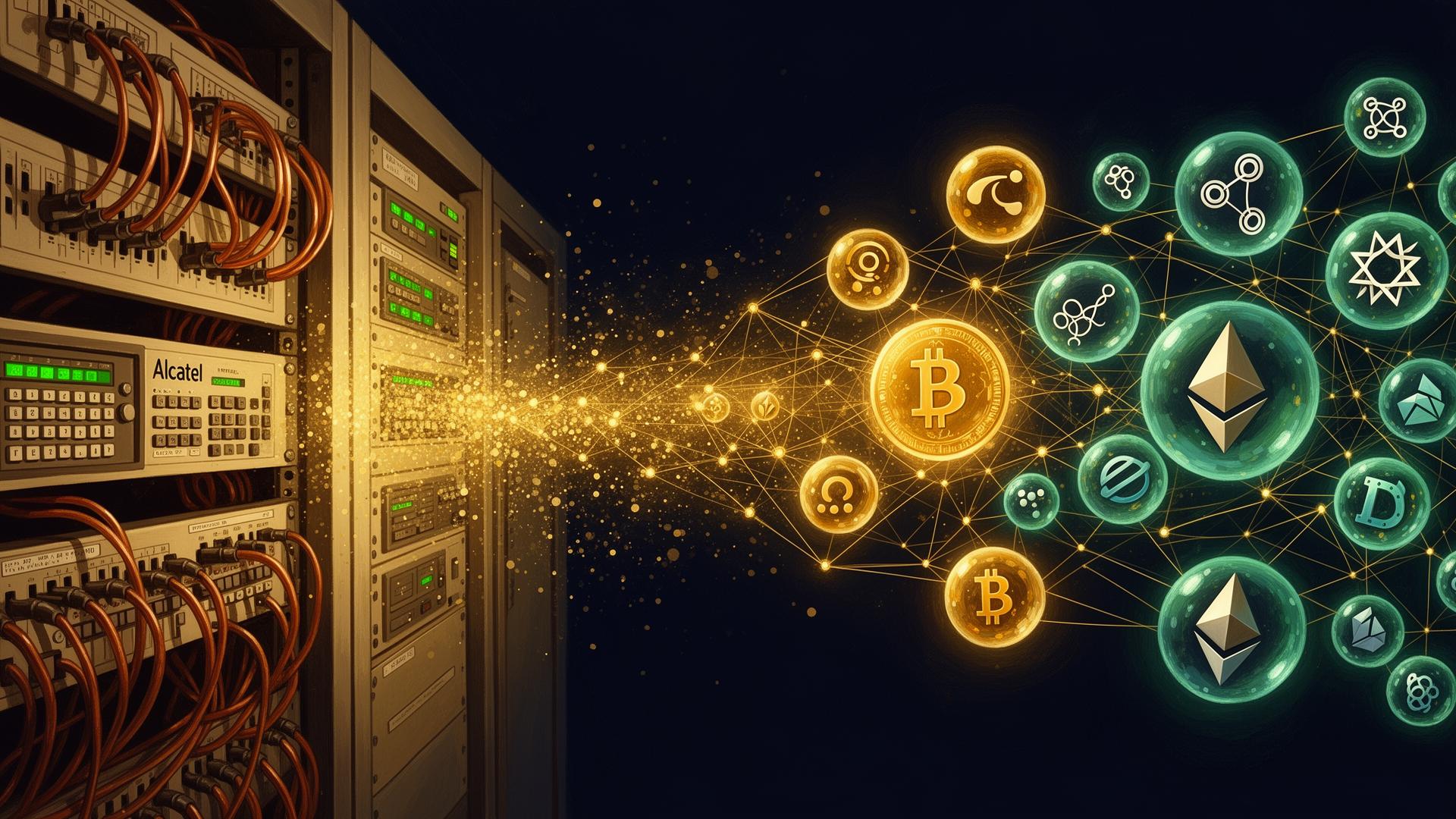
Crypto networks aren't magic. They are the next generation of the same thing humanity has been building for 150 years: telephone centrals. Here is how I see them — and why LOVE L1 is the next central with a heart.
Tribute — kapo dol
To everyone who ever held a screwdriver in a switch room
Before there was a blockchain, there were people. Engineers, technicians, fitters, night-shift operators. They pulled cables through hospitals, schools, banks, ports. They climbed poles in storms. They debugged a buzzing line at three in the morning so a doctor could reach a parent.
Companies like Alcatel-Lucent, Mitel, Cisco, Avaya, Nortel, Siemens, Ericsson, Panasonic, NEC — and a thousand smaller workshops the public never heard of — spent decades, billions of dollars, mountains of patents and oceans of patience so that two human beings far apart could simply say hello.
My father Slavko (@slavko) was one of them. Hundreds of centrals went through his hands — in hospitals, in offices, in clinics. I grew up watching what it means to make something that has to work, today and in twenty years, without an excuse.
Then came the crypto generation. Satoshi, the Stellar team, Vitalik, Anatoly, CZ, and tens of thousands of unnamed contributors who carried the same baton: how do we let humans exchange value the way we let them exchange voice?
Without their work, you and I are not having this conversation. There is no LOVE Coin, no LOVE Pay, no LOVE OS. So before anything else: kapo dol. We stand on a hundred years of someone else's overtime.
The analogy
Every chain is a kind of central
Bitcoin
the Alcatel-Lucent era PBX
Bullet-proof, conservative, designed to outlive its makers. Slow to change because it must not break. The bedrock dial-tone of crypto.
Take the discipline.
Stellar
the Mitel / IP-PBX generation
SIP-fast, cheap per call, built-in routing & exchange. Made for value to move the way voice already does — in seconds, anywhere.
Take the speed and the rails.
Ethereum
the Cisco Call Manager world
The programmable central — dial plans become smart contracts, every line of business gets its own logic. Heavy, but infinitely flexible.
Take the programmability.
Solana
the Avaya Aura high-throughput class
Built for huge call volumes per second. Sometimes it stumbles — but when it runs, it really runs.
Take the throughput.
BNB Chain
the Panasonic / NEC SMB workhorse
Cheap, reliable, ubiquitous in small and medium businesses. Centralised, but it gets the daily job done.
Take the accessibility.
LOVE L1
A universal central — with a heart
LOVE L1 is not 'another chain'. It is the attempt to fuse what the previous generations already proved: Bitcoin's discipline, Stellar's speed, Ethereum's programmability, Solana's throughput, BNB-class accessibility — and on top of that, something none of them carries by design: a heart.
Heart means: a treasury (🏛️) instead of pure burn. Transparent holders. A Code of Honor. A community that is the shield, not the product. 30–80% of service revenues going back into the vault for the people who actually use the network. LPCP, Spirit Bond, Pot Srca, Sonce — features no PBX vendor ever shipped, because no PBX vendor ever asked: who is this for?
We know perfection is not the goal — and we don't even want it. We want the path. Like crossing a forest with no map: sometimes there is no trail. But look at what we already carry. Look at what we already built. If someone left us in the middle of that forest tomorrow, we would still walk out. That is the strength. That is what is already here.
Dr. Miro Cerar would, I think, agree with one thing: respect the foundation, build on top of it lawfully, and leave it better than you found it.